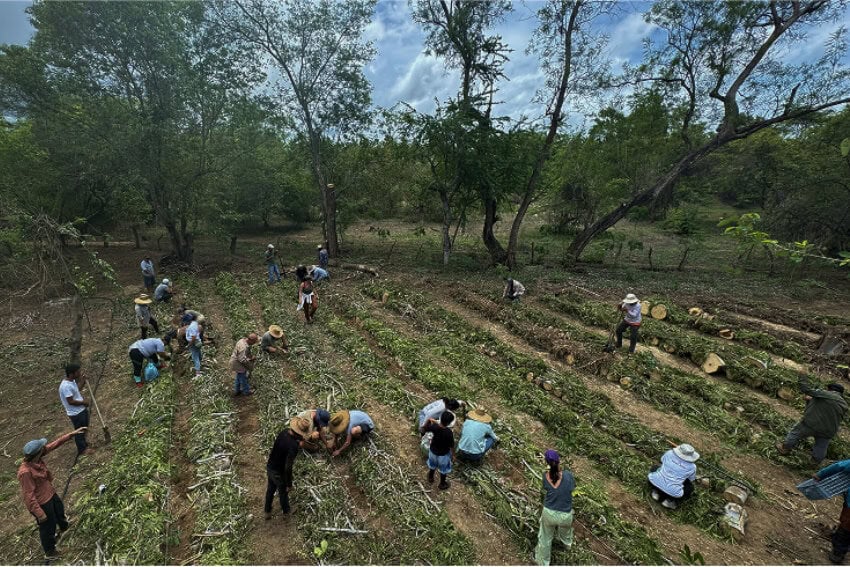
Al amanecer en Juluchuca, en la Costa Grande de México, un coro de garzas se alza desde los manglares que hace apenas una generación se marchitaron y se asfixiaron bajo el peso del ganado y los monocultivos de coco. Hoy, el agua salobre serpentea por el estuario, los camarones chapotean en las aguas poco profundas y los niños comprueban su claridad con kits caseros. Lo que comenzó en Playa Viva , un eco-resort autosuficiente a 35 kilómetros al sur de Ixtapa-Zihuatanejo, como un pequeño experimento de regeneración de tierras, se ha convertido en la semilla de ReSiMar : un modelo para restaurar cuencas hidrográficas y reconstruir comunidades «desde la cima de la montaña hasta el arrecife» a lo largo de la costa del Pacífico mexicano.
Las raíces de la regeneración
Hace dos décadas, mucho antes de que ReSiMar tuviera nombre, el maestro diseñador de permacultura Odin Ruz llegó para inspeccionar un paisaje devastado. Los monocultivos de cocoteros habían drenado los humedales y destruido las lagunas. Algunas sesiones iniciales de planificación del Grupo Regenesis ayudaron a esbozar la visión general del proyecto, pero fue Ruz quien la llevó a la práctica.
“Antes de empezar a construir, lo más importante era observar”, dijo Ruz. “Esperamos dos años por los permisos, así que aproveché ese tiempo para estudiar cómo se movía el agua, cómo respiraba el manglar a través de las diferentes estaciones”.
El equipo de Ruz reabrió los canales estuarinos bloqueados, plantó manglares rojos, blancos y negros, y trazó un mapa de toda la propiedad según el flujo natural del agua. «El primer diseño que se hace en un terreno determina cómo se desarrollará todo a partir de ahí», afirmó. «Se trataba de sembrar la permacultura».
Uno de los mayores obstáculos fue el escepticismo de los pescadores de la zona, que durante mucho tiempo habían cortado los manglares para limpiar sus redes y “limpiar” el paisaje.
“Tuvimos que hablar con los pescadores”, recordó, quienes habían visto disminuir drásticamente sus capturas de camarones.
Restaurar la confianza
«Primero hay que cambiar la mentalidad de la gente para poder restaurar el ecosistema», dijo Ruz. Al vincular la abundancia de camarones con la salud de los manglares, poco a poco convirtió a sus adversarios en aliados.
Detrás del proyecto estaban los fundadores del hotel, David Leventhal y Sandra Kahn, con el apoyo de la madre de Kahn, Elena, cuya fundación Guerreros Verdes financió la compra del terreno con la condición de que se siguiera un modelo regenerativo. Su modesta idea —construir un pequeño hotel que respetara el medio ambiente— marcó la pauta de lo que Leventhal más tarde denominó «lujo en la naturaleza».
Ruz dirigió el proyecto de permacultura durante aproximadamente una década antes de marcharse en 2016. Sigue en contacto con los propietarios y aún los visita ocasionalmente. Describe cómo se percibe la transformación nada más entrar en el terreno, señalando que el contraste entre el entorno degradado y el núcleo regenerado de Playa Viva es inmediato.
Al cruzar la puerta de Playa Viva, los visitantes dejan atrás el polvo y la aridez para adentrarse en un oasis vibrante y lleno de vida. Es como pasar de una película en blanco y negro a una en color. Tras coronar una duna, se descubren hermosas construcciones escondidas entre los árboles y las flores, conectadas por pequeños senderos que unen las cabañas.
De complejo ecológico a ReSiMar
Durante las casi dos décadas transcurridas desde que Leventhal y Kahn compraron el terreno, los polvorientos pastizales de Juluchuca dieron paso a un vibrante bosque de manglares, exuberantes jardines, una laguna revitalizada y un creciente flujo de visitantes atraídos por el proyecto. Para 2018, dicho proyecto se había formalizado en ReSiMar, un programa colaborativo que vincula Playa Viva con la organización sin fines de lucro Legacy Regenerativa México, liderado por el diseñador de sistemas James Honey, director en México de LegacyWorks Group .
The story of regeneration at Playa Viva is centuries deep. Long before building began, the team researched Playa Viva’s ancient use. The earliest known inhabitants of this region were the Cuicatecos, an Indigenous people whose culture was shaped by contact with powerful neighboring civilizations — first Teotihuacán, then the Toltecs. Archaeologists note that the Toltec and Teotihuacán influence reached deep into rural societies, bringing advanced technologies, social organization and art to the region.
“Before David and Sandra even put a shovel in the ground here, what they did was work with Bill Reed to create a history of place,” said Kerry Skinner, Playa Viva’s marketing and special projects manager. “We have information on the land here, dating back from the artifacts … showing that the community created agricultural terraces that we now use on our permaculture farm as swales to plant water. That history of place really dictates everything that we do.”
Perhaps not coincidentally, the Cuicatecos are noted by scholars for possessing a remarkable traditional ecological knowledge — managing biodiversity, regulating hunting and gathering, and maintaining sustainable relationships with their forests and animals. Their worldview equated the health of the land and animals with the well-being of the community, and communitarian rules for conservation remain vital to their culture today. The last speaker of the Cuitlatec (Cuicatlateco) language died in the 1960s, leaving no descendants.
A legacy of sustainability
This legacy of careful management — and the belief that land, water and community are inseparable — finds new life at Playa Viva. Honey described ReSiMar as “a living laboratory for watershed regeneration” organized around five nodes — water, permaculture and agroecology, education, terrestrial conservation and marine conservation — that are woven together by governance, storytelling and financial sustainability. “It’s about connecting communities from the mountains to the sea,” he said. “When people understand the whole system, they begin to act as one watershed.”
Skinner helps translate that science into everyday experience for guests and partners. “For Playa Viva, the aim is always to give guests a different kind of tourist experience,” she said. “You really can make a positive impact when you travel beyond just flying and flopping and having a nice time. Whether it’s releasing a baby turtle or sitting down with community leaders to hear about our restoration work.”
Measuring the change
Nearly 20 years after Ruz first redrew the hydrology map, the results are visible and, importantly, measurable. According to Honey, ReSiMar monitors biological and social indicators across the 30-square-kilometer watershed.
“One of the pieces I’m most excited about is our citizens’ water monitoring that’s taking place now,” said Honey. “We have a water coordinator. The citizens’ water monitoring is a way for students, parents, agriculturalists, ranchers and ejido members to go out, and via several natural indicators … they’re looking at what’s happening with their water.”
Citizens Water Monitoring is a program of Fondo para la Comunicación y Educación Ambiental (FCEA). The group’s staff are the innovators behind, among others, Mexico’s premier portal on water issues: Agua.org.mx. The system FCEA has developed, based on simple natural indicators like bugs in the water or plants on the banks, is being used by another major conservation organization, Fondo Mexicano para la Conservación de la Naturaleza. Over 30 watershed restoration efforts across Mexico are now monitored by citizens with this method.
Students are now at the forefront of environmental change in Juluchuca’s watershed, according to Honey, and they’ve earned the new title of eco-agentes. Over the coming year, youth and local residents will collect data and start asking what actions they want to take next.
When children spark these challenging conversations, adults are more inclined to rethink longstanding community habits, such as livestock or chemical management, Honey points out.
“These are tough things. It’s how we’re managing our cattle, how much pesticide or herbicide we’re spraying on our mangoes,” he said. “This is really exciting, to think about youth asking those questions and leading the early action. We humans all tend to listen to our youth.”
A new curriculum
ReSiMar developed a formal year-long regenerative education curriculum in partnership with Enseña por México and Mexicanos Primeros — one designed to restore “sensitivity, observation and creativity in students.”
As Skinner explains, “That curriculum that was born here in this watershed is now like a formalized project proposal that could be rolled out in schools across the country. Enseña por México and Mexicanos Primeros both have collaborated on this project and formalized our regenerative education curriculum into a replicable guide. The aim is for it to be rolled out in schools across Mexico and beyond.”
Education advocates say the impact is already visible. Patricia Vazquez, CEO of Mexicanos Primero, notes: “Investing in education is investing in regeneration itself. Through our partnership with MIA, the Juluchuca summer learning camps showed that when children learn at their real level and reconnect with nature, their progress in reading, math and confidence grows in just weeks — proving that the future we want starts in the classroom.”
The quiet revolution: women at the center
The project’s most transformative design may be social: the expansion of leadership and agency to local women for the first time in the community’s history. The permaculture team’s founding of the Juluchuca Women’s Cooperative has meant much more than adding hands to the farm or introducing seasonal crops like turmeric and moringa. For many participants — some recent college graduates, some mothers — the cooperative is redefining possibility in a place where women’s public roles, farm management and ecological leadership were rare until now.
Beyond the Women’s Cooperative, four female Mexican node leaders are running ReSiMar on the ground: Ximena Rodríguez, Osmaira Hernández, Larissa Hernández and Viridiana Contreras.
“I can’t help but think that when the entirety of the operation is run by young women,” Honey reflects, “that that is not in every single moment changing our collective assumption about what is possible. And so that may be perhaps our biggest impact. It won’t be in the acres, and it won’t be in the curcuma, and it won’t be in the turtle yields. But it may very well be in what we will see one generation along the line because of who these women are and what they’re doing in that community.”
Nature-oriented design
Playa Viva is designed to blur the boundary between human dwelling and thriving ecosystem. The resort operates completely off-grid through solar arrays and battery storage, its water managed by systems that capture, filter and reuse both greywater and rain. Buildings are raised with bamboo, local woods and adobe, crafted to allow breezes and birdsong to pass through wide, open walls. From the moment visitors arrive, they move along winding trails under the forest canopy, passing native plantings that restore the old dune and estuary corridors. Every structure sits lightly on the land, clustered carefully to maximize shade, breezes and vistas, while leaving wildlife corridors intact.
The communal heart is the dining area, intentionally designed for meeting others. “The communal area — even the dining room is one big piece,” explained Ruz. “You sit down, and somebody’s on your side, and you start talking. It’s what’s called social architecture —the space is meant to bring people together, not separate them. Here, you’re kind of obligated to interact by how it’s planned.”
Education as Regeneration
If women’s leadership is the most transformative aspect of ReSiMar’s design, education is its clearest metric for change. The project’s regenerative curriculum, created with Enseña Por México and Mexicanos Primero, now moves from pilot to practice in Juluchuca’s schools. It’s “a formalized project proposal that could be rolled out in schools across the country,” as the team describes, aiming to restore “sensitivity, observation and creativity in students.”
A medida que el modelo educativo de ReSiMar evoluciona, los resultados ya son visibles en las escuelas de la cuenca hidrográfica. Patricia Vázquez, directora general de Mexicanos Primero, señaló: “Invertir en educación es invertir en la regeneración misma. Gracias a nuestra alianza con MIA, los campamentos de verano de Juluchuca demostraron que cuando los niños aprenden a su nivel y se reconectan con la naturaleza, su progreso en lectura, matemáticas y confianza crece en tan solo unas semanas, lo que prueba que el futuro que queremos comienza en el aula”.
El programa « Apadrina a un Estudiante », financiado por los huéspedes de Playa Viva y otros donantes, permite que los niños de la localidad continúen sus estudios al cubrir los gastos de uniformes, materiales y matrícula que, de otro modo, los obligarían a abandonar la escuela. Muchos de los primeros estudiantes apadrinados ahora son mentores de niños más pequeños y dirigen programas de verano, creando un círculo virtuoso para la próxima generación. Mientras tanto, la cooperativa local de mujeres transforma las habilidades aprendidas en la granja en pequeños negocios, lo que mantiene los ingresos en la comunidad y consolida la regeneración como un valor familiar.
“La regeneración comienza en la mente colectiva”, dice Honey sobre la estrategia. “Cuando la gente cambia su percepción de la tierra, las políticas y la economía cambian en consecuencia”.
Escalando el modelo
El equipo de ReSiMar está aplicando el modelo Juluchuca más allá de Guerrero. LegacyWorks ha contribuido a la creación de alianzas regionales en Costalegre , Baja California Sur y Oaxaca, donde comunidades y desarrolladores experimentan con la planificación integral, desde la cordillera hasta el arrecife. Honey describió una «espiral de impacto» que comienza a pequeña escala, se profundiza a nivel local y luego se expande.
La Comisión Nacional Forestal (CONAFOR), Mexicanos Primero, Enseña Por México y muchas otras organizaciones han colaborado, mientras que nuevos inversionistas turísticos citan Playa Viva como prueba de que la regeneración puede ser rentable. El enfoque, señala Honey, consiste en “crear una visión común, un espacio para todos. Y entonces los resultados generan una retribución mucho mayor que la aportación inicial. Eso es fundamental. Y lo sabemos desde hace mucho tiempo”.